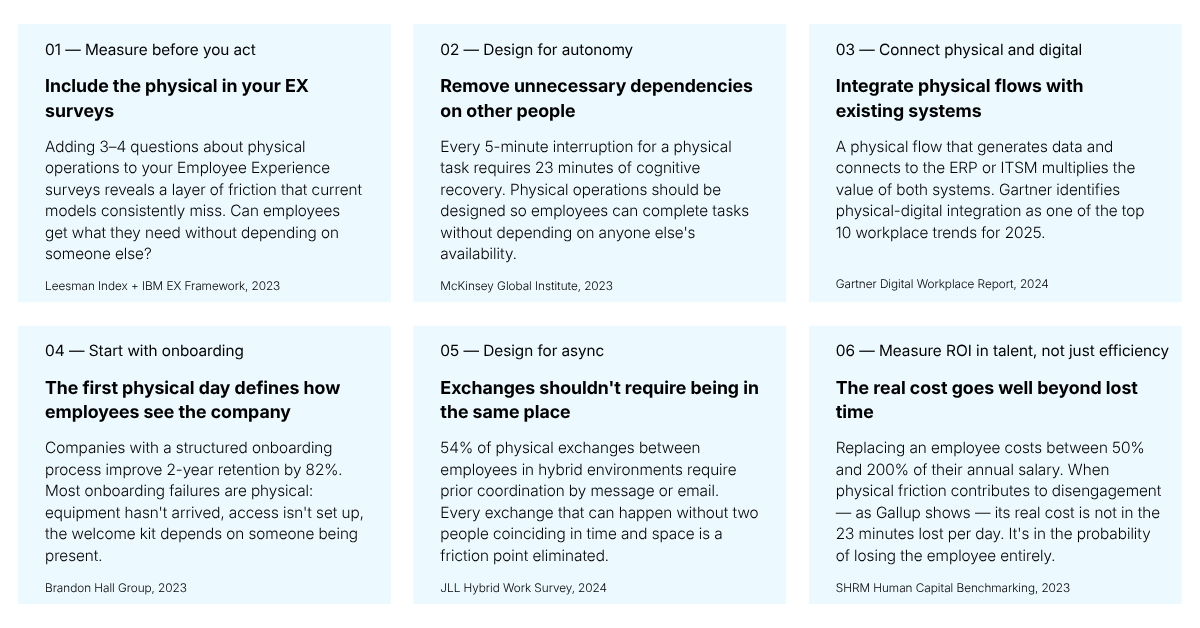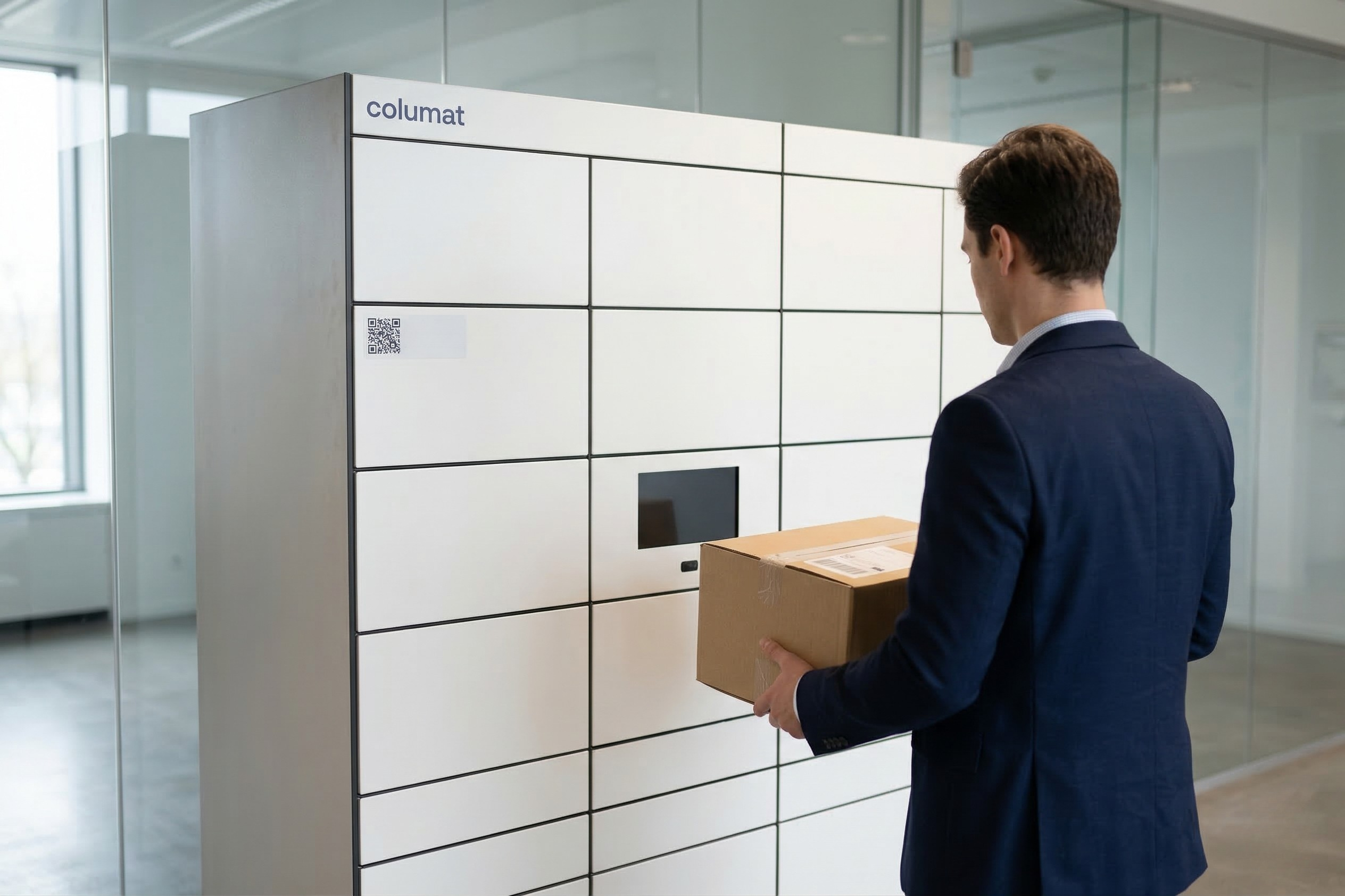
There is something that rarely appears in these models: what happens in the physical operations of everyday work. What occurs when an employee needs to pick up a package, return a piece of equipment, or access something that someone else has on a different shift. Everything, in other words, that does not happen on a screen.
We have built a sophisticated framework — but left out an essential part of how work actually functions.
THE CURRENT STATE - EXTERNAL DATA
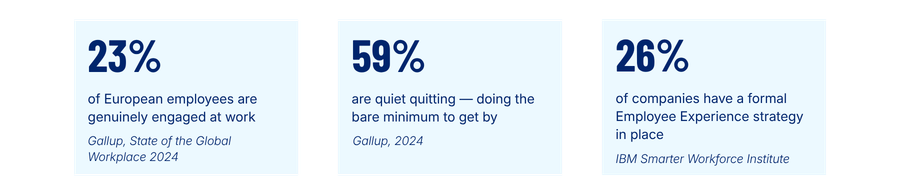
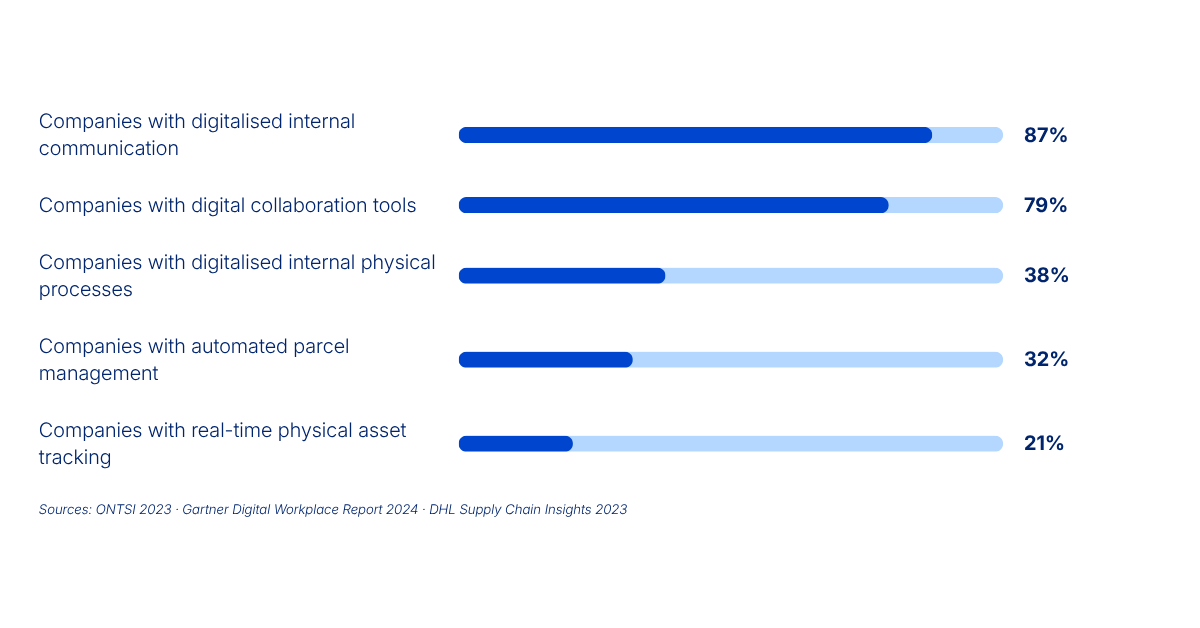
Only 26% of companies have a formal Employee Experience strategy today, according to the IBM Smarter Workforce Institute. And those that do have built it almost exclusively around the digital layer: communication, collaboration, documents. Rarely around the physical.
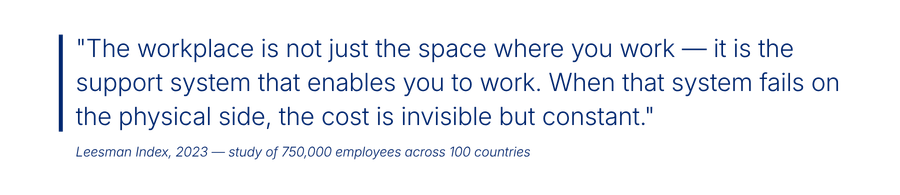
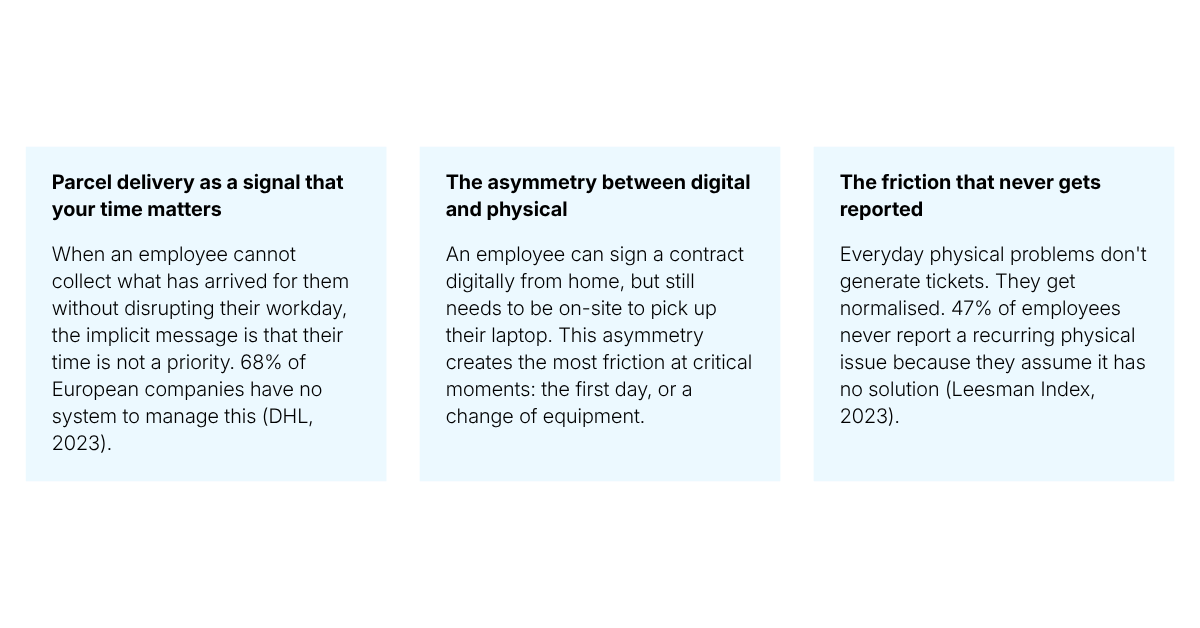
Physical problems in the workplace have a particular quality: they get normalised. When something fails repeatedly and has no obvious solution, it stops being perceived as a problem and starts being accepted as part of the environment.
This is how invisible friction appears. It rarely gets measured, but it is felt — in lost time, in constant interruptions, in the daily dependence on other people for simple tasks. According to JLL (2024), employees spend an average of 23 minutes a day on physical administrative tasks that could be automated. For a company of 500 people at an average cost of €25 per hour, that is more than €300,000 a year in productivity that simply disappears.
Receptions overwhelmed by parcels — the volume of packages in corporate environments has grown 47% since 2019 (DHL), while 68% of European companies still have no formal system to manage them —, exchanges that require people to be in the same place at the same time, manual tasks that could be automated. These are small failures that, accumulated, directly affect the employee experience. Gallup confirms it from another angle: only 23% of employees in Europe are genuinely committed to their work — the lowest level worldwide — and daily operational friction is one of the main factors eroding that commitment.
THE 3 MOST COMMON BLIND SPOTS IN CURRENT EX MODELS
We call this layer Physical Employee Experience (PEX): the experience an employee has across all the physical operations required to do their job.
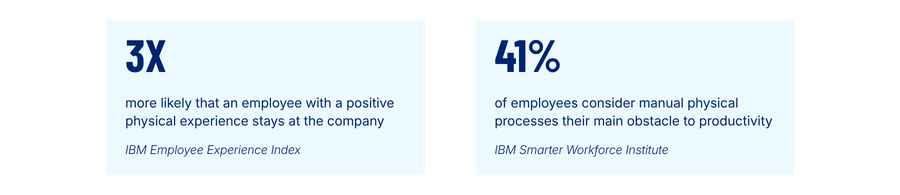
The IBM Employee Experience Index puts it in perspective: employees with a positive experience are three times more likely to stay with their company. Yet the models measuring that experience almost never include the physical. They don't ask whether the employee could collect their package without interrupting their day, whether they returned their IT equipment without depending on someone being available, or whether they accessed what they needed without sending three messages first.
PEX improves when that operational layer stops generating friction: when you can access what you need without depending on anyone else, when there is full traceability, when exchanges don't require being in the same place at the same time, and when the physical is connected to the digital systems around it.
When this happens, everything flows. And that is precisely why it goes unnoticed.
We have digitalised communication, collaboration and documents. But physical operations still function, in many cases, the same way they did years ago. The ONTSI confirms that only 61% of large Spanish companies have their internal processes fully digitalised, and that the services sector loses €2.4 billion a year in avoidable operational inefficiencies.
This is where most of the daily friction concentrates. Digitalising this layer is not a question of design — it is a question of infrastructure: connecting physical flows with the same logic we already apply to digital ones.
When that happens, employee experience will finally be complete. Because it will start to reflect how work actually functions.