The logistics industry in Europe is entering a decisive moment of transformation. Over the past decade, the explosive growth of e-commerce forced logistics networks to expand rapidly: more warehouses, more transport capacity, and increasingly complex delivery networks designed to meet rising consumer expectations.
For a time, the model worked. Logistics operators scaled infrastructure, retailers embraced omnichannel strategies, and consumers grew accustomed to fast home delivery as the standard.
But the environment has changed.
Today, logistics companies face a combination of pressures that are fundamentally altering how supply chains operate: labour shortages, rising operational costs, stricter sustainability regulations, and increasing restrictions on urban mobility. At the same time, parcel volumes continue to grow, particularly in metropolitan areas where delivery density is highest.
The question is no longer how to deliver more parcels.
The real challenge is how to deliver them more efficiently, more sustainably, and at scale.
Increasingly, the answer is emerging through a structural shift in last-mile logistics: the rapid expansion of out-of-home delivery networks and PUDO points (Pick Up Drop Off locations) supported by smart locker infrastructure.
Despite economic volatility, the European logistics market continues to grow steadily. Logistics remains a critical component of the continent’s economic infrastructure, supporting trade, e-commerce, manufacturing, and cross-border supply chains.
The transport sector alone represents roughly five percent of the European Union’s GDP and provides employment to more than ten million people. Meanwhile, the logistics market itself continues to expand as digital commerce reshapes how goods move between businesses and consumers.
However, growth is now taking place under significantly more demanding conditions.
Labour shortages across transport and warehousing are becoming structural. Energy costs remain volatile. Environmental regulation is tightening rapidly across Europe, pushing operators toward more sustainable logistics models. And urban environments are increasingly difficult for delivery vehicles to navigate due to congestion and low-emission zones.
At the same time, consumer expectations continue to rise. Faster delivery, greater transparency, and seamless return processes have become standard expectations across e-commerce markets.
The result is a sector that continues to grow but must operate with far greater efficiency than before.
.avif)
This evolving landscape is forcing logistics companies to rethink one of the most expensive and complex parts of the entire supply chain: the last mile.
The final stage of the supply chain has always been operationally demanding. Delivering a parcel to an individual address requires navigating traffic, locating the recipient, managing access to buildings, and often handling failed delivery attempts.
As e-commerce volumes increase, these challenges are amplified.
.avif)
In many parcel networks today, last-mile delivery accounts for up to 60–70% of total logistics costs. Each individual delivery stop represents a relatively inefficient use of time and resources, particularly in dense urban areas where traffic congestion and parking limitations complicate operations.
Failed deliveries add another layer of complexity. When recipients are not available, parcels must be re-delivered, stored temporarily, or redirected to collection points — all of which increase operational costs.
At the same time, cities across Europe are introducing policies designed to reduce congestion and emissions, including low-emission zones and stricter regulations on delivery vehicles.
Together, these factors make it increasingly difficult for logistics operators to rely exclusively on traditional home delivery models.
To remain efficient, logistics networks must find ways to consolidate deliveries and increase stop density without sacrificing consumer convenience.
This is where out-of-home delivery networks are rapidly gaining momentum.
Out-of-home delivery fundamentally changes how parcels move through urban environments.
Instead of delivering each package individually to a private address, parcels are delivered to shared collection points where consumers can retrieve them at their convenience. These locations may include parcel lockers, retail collection points, transport hubs, or dedicated logistics infrastructure.
From an operational perspective, this model dramatically improves efficiency.
A single delivery stop at a parcel locker or pickup point can replace dozens of individual home deliveries. Couriers can unload multiple parcels at once, reducing travel time, optimizing routes, and lowering fuel consumption.
This consolidation of deliveries allows logistics operators to increase parcel density per route, improving productivity and reducing operational costs.
From the consumer perspective, out-of-home delivery also offers greater flexibility. Instead of waiting for a courier during a narrow delivery window, customers can collect their parcels when it suits their schedule.
For many urban consumers, this level of convenience has become a decisive factor.
Pick Up Drop Off locations — commonly known as PUDO points — are quickly becoming one of the most important components of modern last-mile logistics networks.
These locations act as shared delivery hubs where parcels can be dropped off, collected, or returned. They can take many forms, including retail stores, convenience shops, service points, or automated parcel locker systems.
The expansion of PUDO networks offers several advantages for logistics operators.
First, they increase delivery density. Instead of visiting multiple individual addresses, couriers can deliver many parcels in a single stop. This significantly improves route efficiency.
Second, they help reduce failed deliveries, which remain one of the most costly challenges in e-commerce logistics. When parcels are delivered to PUDO points, recipients can collect them later, eliminating the need for repeated delivery attempts.
Third, they support the growing importance of returns in online commerce. Consumers can easily return items through the same network of pickup points, simplifying reverse logistics operations.
As parcel volumes continue to rise, these networks are becoming an essential layer of infrastructure connecting logistics operators, retailers, and consumers.
Among the different types of PUDO infrastructure, Smart Lockers are emerging as one of the most scalable solutions for last-mile delivery.
Smart Lockers provide secure, automated parcel storage that can operate continuously without staff intervention. Couriers can deposit parcels quickly, and recipients can collect them at any time using digital authentication.
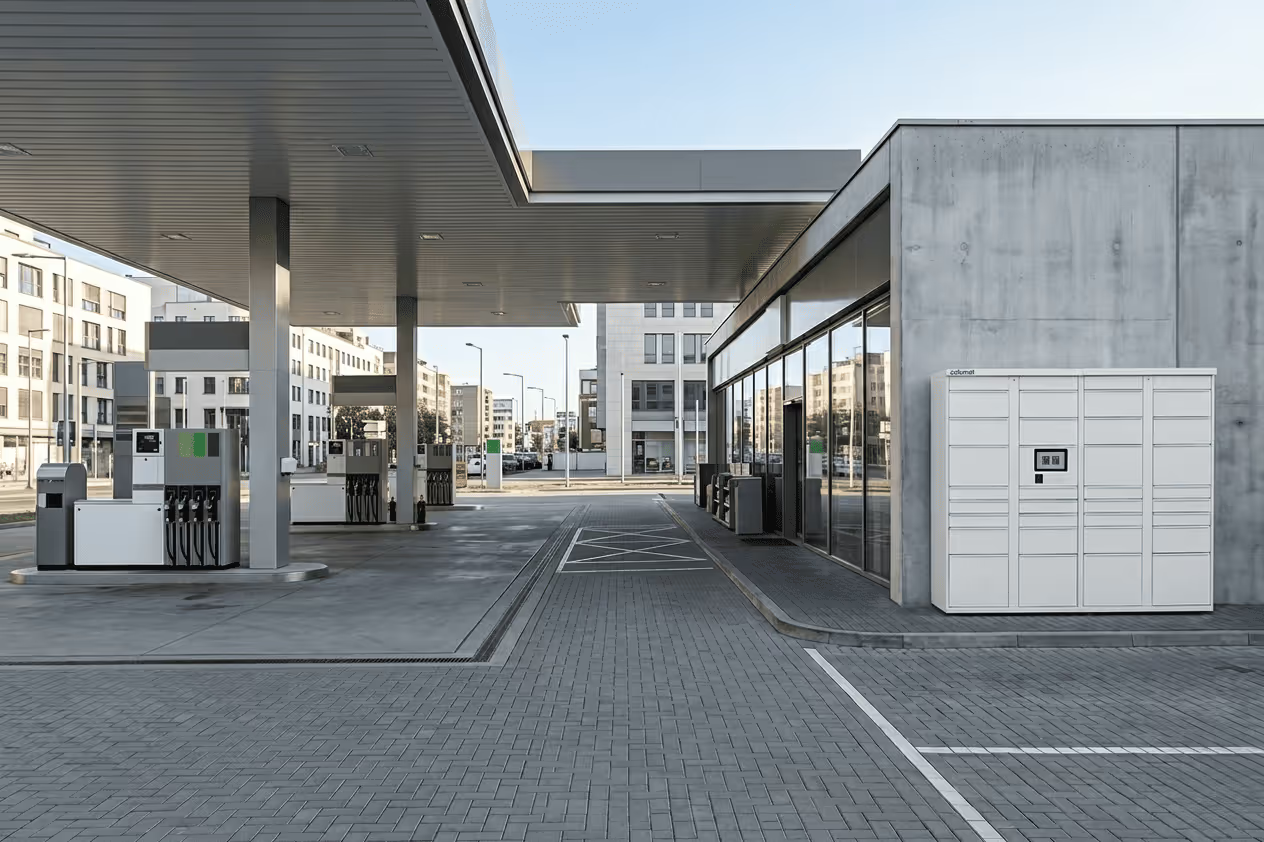
Because lockers are automated and highly modular, they can be installed in a wide variety of environments — residential complexes, office buildings, transport hubs, shopping centres, and public spaces.
From a logistics perspective, the advantages are significant.
Smart Lockers drastically reduce delivery time per stop, eliminate failed deliveries, and enable operators to optimize routes more efficiently. Multiple parcels can be delivered simultaneously, which improves courier productivity and reduces operational costs.
For cities, Smart Locker networks help consolidate deliveries, reducing traffic congestion and supporting more sustainable urban logistics.
For consumers, they provide convenience, security, and flexibility — three factors that increasingly influence purchasing behaviour in e-commerce.
As e-commerce continues to grow, the need for more efficient delivery models will only intensify. Urban parcel volumes are expected to increase significantly over the coming years, placing additional pressure on existing logistics infrastructure.
Without new delivery models, cities risk facing severe congestion and environmental challenges.
Out-of-home delivery networks, supported by PUDO points and Smart Locker ecosystem, offer a scalable alternative that balances efficiency for logistics operators with flexibility for consumers.
Rather than replacing home delivery entirely, these networks complement existing logistics systems, creating a hybrid delivery ecosystem where parcels can reach consumers through multiple channels depending on convenience and efficiency.
The future of logistics will not be defined solely by faster delivery. It will be defined by smarter delivery models that combine efficiency, sustainability, and consumer convenience.
Out-of-home delivery networks, PUDO points, and Smart Lockers represent a structural evolution in the way parcels move through cities. By consolidating deliveries, reducing operational friction, and improving network efficiency, they allow logistics operators to scale while responding to the challenges of modern urban environments.
At Columat, we believe that Smart Locker ecosystem will play a central role in this transformation. Our solutions are designed to support last-mile logistics networks, out-of-home delivery models, and PUDO ecosystems, helping logistics operators, retailers, and cities build more efficient delivery infrastructures.
Because the next generation of logistics will not simply deliver more parcels.
It will deliver them in smarter ways.